Wesley Chapel Root Removal from Sewer Lines
Roots do not break into a sewer line so much as find a way in. A pipe full of warm, wet, nutrient-rich water is the best thing growing near a loose joint, and a hairline gap is all a root hair needs. Once inside, the root thickens, catches paper and grease, and the line starts to slow.
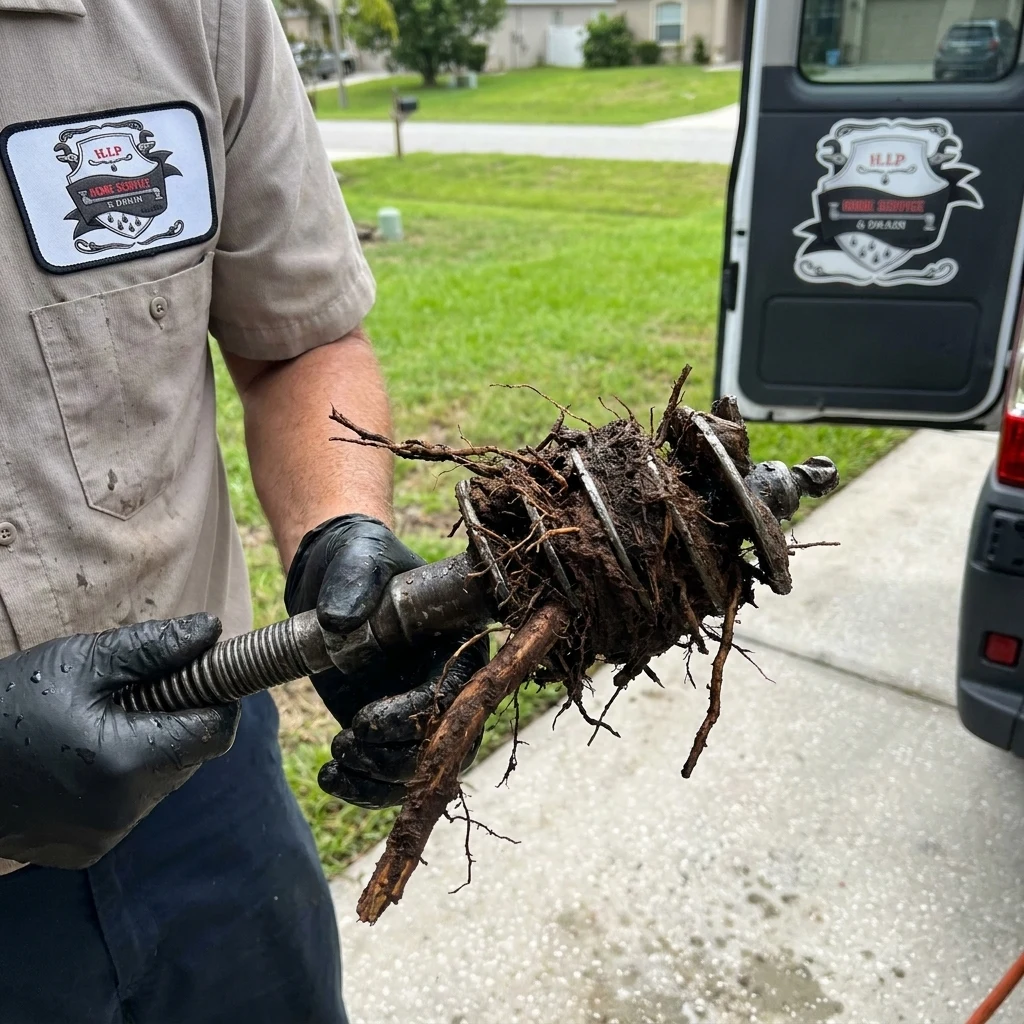
Root removal is a cutting job first and a flushing job second. We cut the mass free, wash the pieces out, and look at the pipe to see how the roots got in, because that decides how soon they come back.
Signs Roots Are in Your Sewer Line
Root problems have a recognizable pattern:
- Backups that return after each cable cleaning, a little sooner every time
- Toilets gurgle or drain slowly first, then the whole house follows
- Fine, hair-like roots or a fibrous tangle on the cable when it comes out
- A cleanout that holds standing water
- A mature tree or large shrub close to the line’s path
- An older lateral in clay, cast iron or Orangeburg, where joints are the weak point
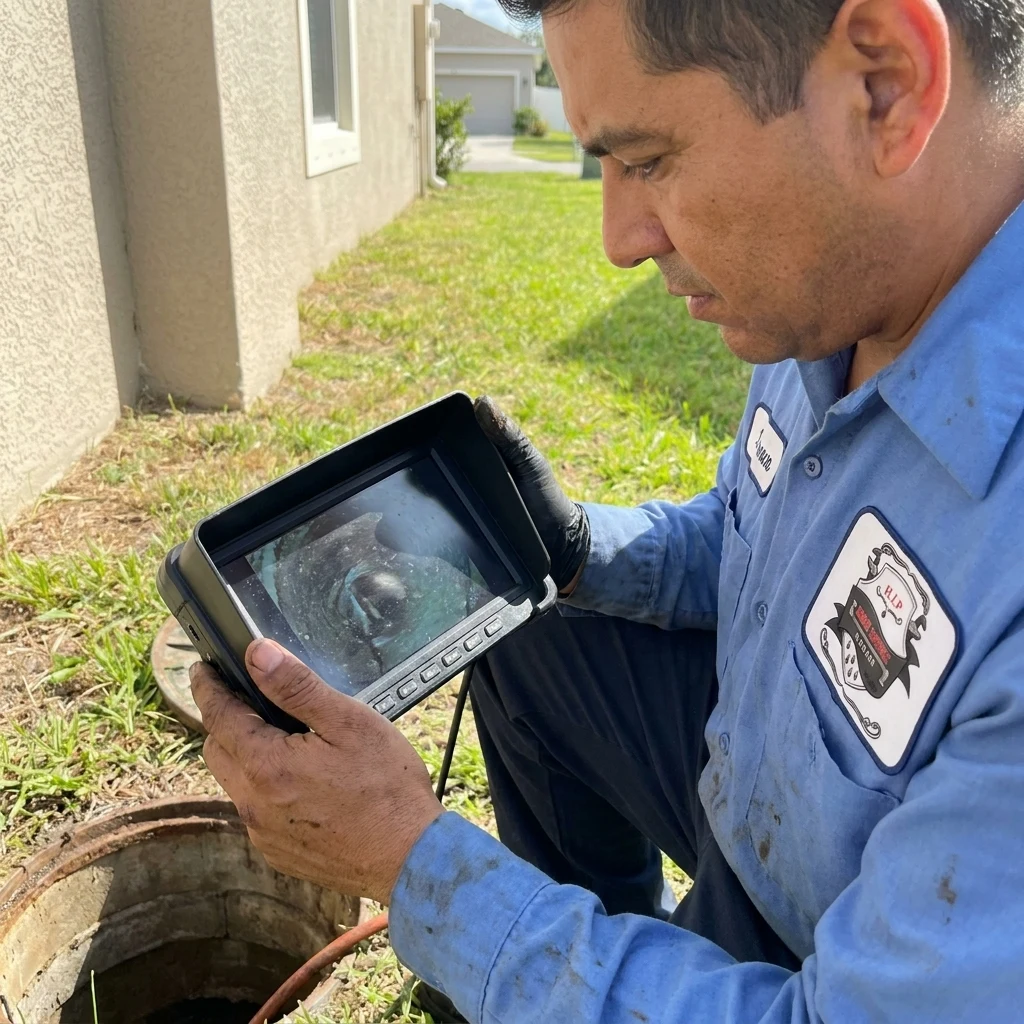
- A camera pass showing root hairs at a joint or fitting
Root-Cutting Nozzles vs Chemical Root Killers
Foaming root killers are poured in at a toilet or cleanout and coat the wall with a herbicide that burns the roots it touches. They may slow fine regrowth. They do not remove roots already in the pipe, and they do nothing for a line that is half blocked. Mechanical cutting takes the mass out, which is why our post on root-cutting nozzles versus chemical root killers ranks the two as different tools for different stages.
A cutter head on a cable, or a jetter nozzle with cutting edges, shears roots at the wall. Root-cutting nozzles are designed for more flow than small residential machines deliver, so a heavy mass may need a mechanical cutter first and jetting after to wash the pipe clean. The camera tells us which order to use, and it shows whether the roots came in at a joint or through a crack.
Species matters less than distance and pipe age, because roots head for moisture. Most Wesley Chapel subdivisions have young trees and plastic pipe, so root calls skew toward older neighborhoods, golf-course lots and any spot where a mature oak stands near the line. Clay, cast iron and Orangeburg joints are easier for roots to enter than PVC.
Root Removal Cost in Wesley Chapel, Repeat Visits and Limits
Main line hydro jetting with moderate roots runs $400–$750, and a main line snake run is $225–$450. A camera inspection is $150–$300 and is often credited toward the work when you go ahead the same visit. Heavier masses and longer runs sit toward the top of the range.
Roots grow back unless the cause changes. A line with a tree beside it may need a repeat cleaning, and the honest way to set the interval is to take a camera pass a few months after the first one and see how much has refilled. We do not promise the roots are gone for good.
Roots that have split, crushed or shifted the pipe are a repair, not a cleaning. Jetting a broken line, or an Orangeburg lateral already delaminating, can make it worse. When the footage shows that, we say so and recommend a plumber or repair contractor.
Where We Run Root Removal in Wesley Chapel and Pasco County
Roots follow moisture to a loose joint, so calls cluster where trees are mature or pipe is old. These are the areas on that list.
- Lexington Oaks — A golf community opened in January 2000, routed through woods, lakes and marshland, with mature landscaping along fairways and ponds. Roots have had decades to reach joints.
- Saddlebrook — A 1970s and 1980s resort and condo pocket, the older end of Wesley Chapel. Older plumbing is possible, so a camera pass comes before any cutting.
- Temple Terrace — Founded in 1920, with Mediterranean Revival homes from that decade, mid-century houses, sand live oaks and Tree City USA status. The strongest case for old pipe plus large trees.
- Odessa — Settled in the mid-1800s on ranch and horse land, with larger lots, mature trees and long laterals that pass more roots. Septic or sewer varies by address.
- Dade City — The county seat has a core of 1920s through 1940s buildings, so older clay, cast iron or Orangeburg laterals are possible, and roots enter those joints more easily than PVC.
- Zephyrhills — Founded as a veterans’ colony in 1909 and incorporated in 1914, the older center sits beside newer subdivisions. Older laterals may have clay or cast iron joints.
- San Antonio — A Catholic colony founded in 1882 and incorporated in 1891, on rolling rural lots with mature trees. Sewer versus septic depends on the address, so we confirm first.
- New Tampa — Pebble Creek is the oldest neighborhood and Tampa Palms the oldest inside city limits. Landscaped lots from the late 1980s and 1990s now carry trees decades old.
Roads and Landmarks on Wesley Chapel Root Removal Jobs
- Lexington Oaks Golf Club — A public par 72 designed by Gordon Lewis and opened in January 2000. Its fairways are lined with the mature plantings that feed roots.
- Saddlebrook Resort — At 5700 Saddlebrook Way. The original course opened in 1976 and a second in 1986, making the grounds older than most Wesley Chapel development.
- Hillsborough River at Temple Terrace — Flows through the east and south of the city, among the sand live oaks that Temple Terrace is known for.
- Downtown Dade City — The Crescent Theatre (1926) and Pasco Theatre (1948) mark a core that predates most of the area, so older pipe is possible nearby.
- Saint Leo University, San Antonio — Sits near San Antonio, a town founded in 1882, where Lake Jovita and rolling terrain shape the lots.
- SR 54 through Odessa — Runs alongside the old Orange Belt Railway corridor through Odessa, a settlement dating to the 1880s with larger lots.
Numbers Behind Wesley Chapel Root Removal
- EPA’s 2004 Report to Congress put roots behind 22 percent of reported sewer blockage events, with another 4 percent split between roots and grease. Roots are the second most reported blockage cause nationally, and they get in at joints and stress points, which is why entry points matter as much as cutting.
- UF/IFAS Extension says tree roots can grow 3 to 4 times the drip line when allowed, and that roots do not seek out pipes but grow wherever moisture and nutrients are adequate. A tree does not have to be close to a lateral to reach it, and a joint that leaks water is the invitation, not the tree species.
- In the 2020-2024 American Community Survey, 49.8 percent of Dade City homes, 43.5 percent of Temple Terrace homes and 34.0 percent of Zephyrhills homes were built before 1980, against 4.4 percent in Wesley Chapel. Older homes are more likely to have clay, cast iron or Orangeburg laterals, whose joints roots enter more easily than PVC.
- Orangeburg fiber sewer pipe has an expected life of about 50 years under ideal conditions, has failed in as little as 10, and its maker had closed by 1974. A brittle pipe full of roots may not survive jetting, which is the reason a camera pass comes before any pressure on an old lateral.
- Trade guidance says root-cutting nozzles are designed for pumps with much higher flow than residential washers deliver, and that heavy roots may need a different machine. Heavy root masses get cut mechanically first and washed out second, so a root job is not simply a bigger jetting job.
Price in writing before work starts
Call or text for a free estimate. The written number stands for 30 days.
CALL 813-733-7188Neighborhoods and Towns We Reach
We book root removal and line clearing visits for homes in Wesley Chapel, Land O' Lakes, Lutz, Odessa, Zephyrhills, Dade City, San Antonio, FL, New Tampa, Temple Terrace, Tampa, Seven Oaks, Meadow Pointe, Wiregrass Ranch, Epperson, Watergrass, Union Park, Chapel Pines, Lexington Oaks, Avalon Park West and Saddlebrook. Not sure your street is covered? Text the address and we will tell you.
Root Removal and Line Clearing: Questions Homeowners Ask
Yes, if the tree and the opening are both still there. Cutting restores flow; it does not close the entry point. Regrowth speed depends on the tree, the moisture and the joint. A camera pass a few months later shows how fast the line is refilling.
It can slow fine roots at the wall, but it does not clear a mass already blocking the pipe, and results vary. Cutting is what restores flow. Some owners use a root killer between cleanings, and we will tell you after the camera pass whether it is worth it for your line.
Not usually as a first step. Many lines can be cleared and then watched. If the camera shows the roots have broken the pipe, or the line fills again quickly, a repair becomes part of the conversation, and that decision belongs to you and a repair contractor.
Roots come out as fibrous tangles and hair-like strands on the cable. Grease comes out soft and waxy. Roots usually start in the main line outside the house, grease more often in the kitchen branch. A camera gives the sure answer.
There is no honest fixed number. Some lines stay clear for a year or more and others refill sooner. We look at how much regrowth the camera shows at the first follow-up and set the interval from that.
Other Ways We Clear a Line
Sewer Line Hydro Jetting
Full main-line cleaning from the house cleanout out to the street connection
Sewer Camera Inspection
Video inspection showing pipe condition, blockages and root entry before and after cleaning
Hydro Jetting Services
High-pressure water jetting that scours grease, scale and debris from drain and sewer lines